


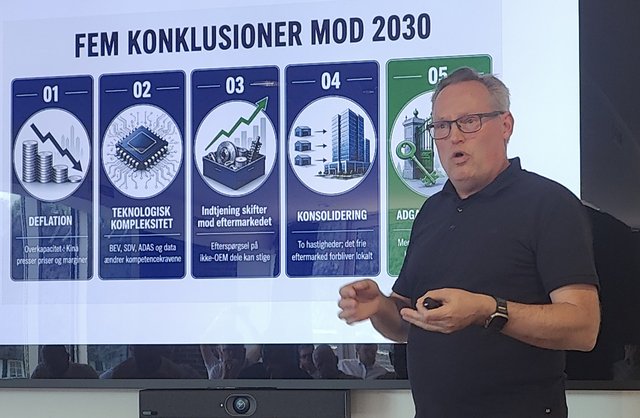
During the annual general meeting of AUTIG (The Danish Automotive Industry Trade and Industry Association) René Tønder, who works as a strategic advisor in the automotive industry, gave his proposal for how the aftermarket will develop towards 2030.
Over the past decade, the automotive industry has been in a time of technological upheaval. Although the car industry has always undergone technological development from its very beginnings, it can in no way be compared to the transition we are in the middle of right now. The competition to be the leader is no longer based on the development of physical (hardware) that follows a linear curve, but instead dominated by the development of binary (software) technology that happens exponentially. Although it has surprised many that the predictions about the speed at which electric cars would gain ground did not come true, it now surprises in the same way how fast the development is accelerating.
European car manufacturers and their value chain are under massive pressure
One of the most significant macro trends is the increasing industrial overcapacity in China – not least in car production, components and battery technology. Chinese producers have built up massive production capacity in recent years, which far exceeds the otherwise declining domestic demand.
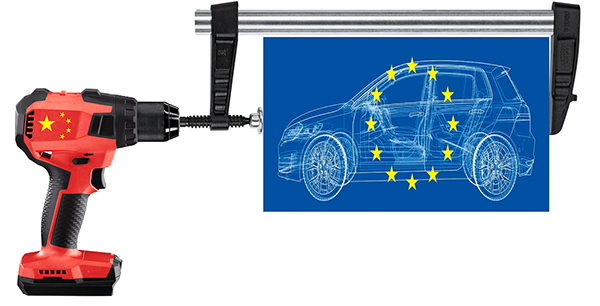
As a consequence of the American market being virtually shut down for the Chinese car manufacturers, they have set their sights on Europe. The direct consequence of this has been increased margin and competitive pressure on the value chain of European car manufacturers. Although the EU is trying to reduce pressure through industrial policy, such as CO2 regulations, battery strategy and fleet requirements, the increased exports to Europe have already caused:
- Pressure on spare parts prices, especially in non-genuine (aftermarket) components
- Marginal erosion at distributors and workshops
- Increased imports of low-cost alternatives that challenge established suppliers
Deflation is not only a price phenomenon, but also a strategic reality: price becomes a key competitive parameter, and players who fail to differentiate themselves risk being squeezed out.
Technological complexity and new competence requirements
As mentioned at the outset, technological development has fundamentally changed and four key development areas today are:
- BEV (Battery Electric Vehicles)
- SDV (Software-Defined Vehicles)
- ADAS (Advanced Driver Assistance Systems)
- Data and connectivity
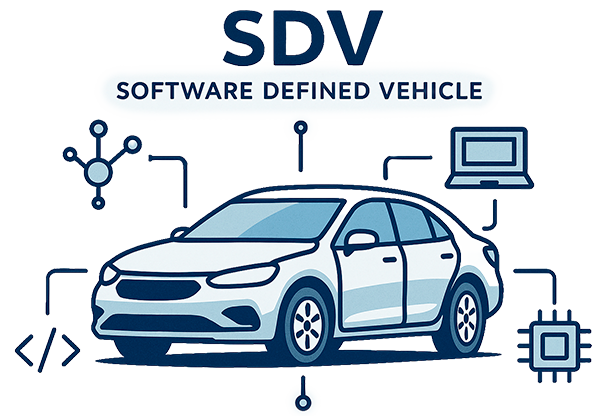
A secondary effect of this is that the aftermarket is undergoing a transformation from mechanical service to software- and system-based maintenance. For workshops in the independent aftermarket, this has the following consequences:
- Traditional workshops must invest in diagnostic equipment, software tools and upskilling
- Less maintenance on the BEV (fewer moving parts) reduces classic service turnover
- An increased need for calibration of sensors (ADAS), software updates and high-voltage competencies
If independent workshops do not manage to close the competence gap, they stand no chance against the competition and authorized workshops. Those who can handle technology survive – the others are marginalized.
Value migrates towards the aftermarket, which is changing in character
The increased pressure on margins at car manufacturers and the increase in the average age of the fleet are leading to value moving towards the aftermarket. This is basically good news for the independent aftermarket.
Of course, this does not come as a shock to the car manufacturers, who are doing everything they can to keep electric car owners in the authorized part of the aftermarket. Measures such as long warranties, the use of captured parts (bound parts that must be coded for the car) and restrictions on access to the car's software and data, are neither good for the owners of the car owners nor the independent aftermarket.
Another challenge for the aftermarket is that it changes character. We already know that electric cars come with an earnings gap that can be attributed to the following two circumstances:
- Earnings will not come until later in the car's life
- A reduced consumption of parts, oil, etc.
Two-speed consolidation
The market is moving towards a clear dichotomy, where the authorized aftermarket players/chains are consolidating aggressively with the aim of establishing larger, capital-strong units and closer integration. The focus is on data, subscription models and total ownership.
The independent operators, on the other hand, remain largely local or regional and aim to survive through flexibility, price and customer loyalty. Many will probably face challenges with technology investments, access to spare parts and competence building.
The result will be a market with fewer, stronger chains at the top and a fragmented base of smaller workshops at the bottom.
Access to data determines everything
Although we are currently experiencing an increase in the average life expectancy of the European car fleet, electric cars will lead to a decreasing demand for wear parts and an increased focus on software- and system-based maintenance. Therefore, regulatory access to data and limiting the ability of car manufacturers to keep the independent aftermarket out are essential. This will leave the car manufacturers and the authorized aftermarket with the warranty as the only real competitive parameter.

The winners will be those who transform themselves
Towards 2030, the automotive aftermarket will be characterised by:
- Lower margins
- Higher technological barrier to entry
- Battle for access to data
- Structural consolidation among the main players
Winners in this market will be those who manage to combine:
- Scale or specialization
- Technological understanding
- Access to data
- Efficient sourcing in a deflationary world
For players such as spare parts suppliers, wholesalers and workshops, this means that transformation is no longer a choice – but a necessity.